By David Winship (Contributing Writer)
On a street off Old Rural Hall Road in Winston-Salem, Samantha Foxx Winship has established Mother’s Finest Urban Family Farm. Nurtured in the projects of Goldsboro, Samantha spent much time in her grandmother’s gardens, which she found to be her “happy place.” She fondly recalls working in the garden, picking tomatoes and cucumbers, and growing up in a community.
Winship took a circuitous route in her adult life, including living in Chicago, a 20-year career in cosmetology, and raising a family. When facing the prospect of raising a son in Chicago, she decided returning to North Carolina would give them both a hopeful future. She found urban farming reconnected her to a nurturing life.
Samantha Winship loves the natural world and has embraced its wonder through growing its wonders, including bees. But bees are not all she tends. Her home farm menagerie includes chickens, turkeys, goats, quail and an attentive boxer dog, who claims he sometimes gets left off the list. But her passion is bees.
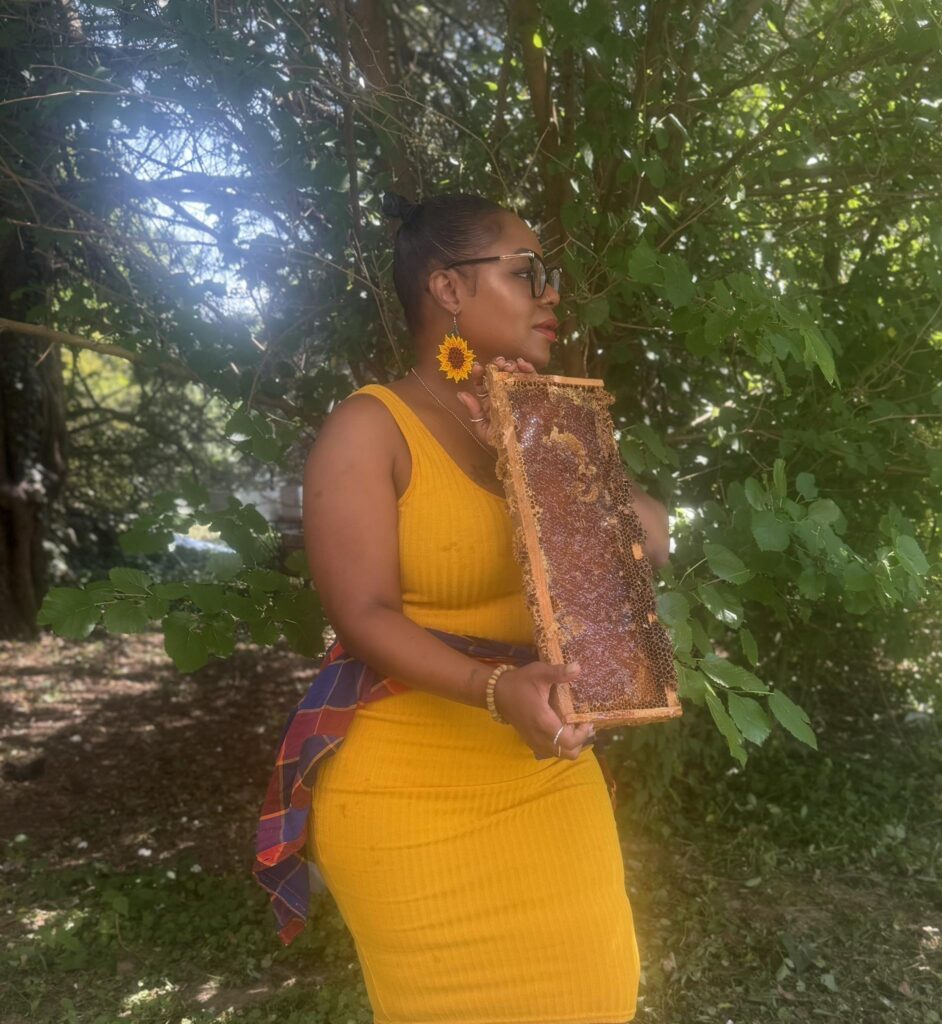
It’s honey season at Mother’s Finest Urban Family Farm. A non-profit urban farm, Mother’s Finest promotes education and community development through beekeeping, farming, and arts/crafts skill-building. As one of only six Black family-owned farms in Forsyth County, which numbers slightly more than 480 family-owned farms, Winship is fervent in her advocacy for the heritage and continuation of Black farming. Her farm covers two acres at her current location, with her bees pollinating in about a mile radius of her farm.
Winship was a key element in the recent documentary, “Believe in Ghosts,” which chronicled the history and heritage of Black farming. Produced in 2022, the 16-minute film has competed in international film festivals and has been utilized in university-level course material to bring this Black history to light. The film shows Winship’s work to preserve agricultural legacy and increase the visibility of Black farmers in the United States. The film highlights her dedication to reconnecting with the soil, promoting healthy consumption, and uplifting her ancestral heritage through beekeeping and farming.
“Believe in Ghosts” addresses the massive decline in Black-owned farmland over the last century and explores the systemic racism and discrimination Black American farmers face. One of Winship’s poems concludes the film. Winship’s promotions in her public work bring attention to the difficulty that Black farmers face to access farmland to continue the heritage of Black farming for the future.
Word of Winship’s bee work has spread, both nationally and internationally, with clients coming from the United Kingdom and Venezuela. She produces a variety of products made from honey, for nutrition from eating, as well as nutrition for the body’s largest organ, the skin. Winship elevates honey in various forms, such as lotions, tonics, and Scoth-bonnet pepper infusions in honey. “That spiciness of the Scotch-bonnet pepper brings a little bit of the West Indian culture into the honey that I find to be beautiful. It brings that sweet and spicy connection.”
She promotes her apitherapy, using honey and bees therapeutically with lotions, salves, and through bee venom. “I use every single item from the hive, treating it as a medicine cabinet,” Winship says. “I’m infusing some traditional methods with the hand-making along with scientific and clinical practice into the apitherapy. I recognize the traditional part of my culture which has healed many people in my family, so I don’t ever want to lose that connection.”
One of her offerings is a meditation-oriented “bee bed therapy room.” This room houses separated hives which allow the hive hum to provide soundscape and vibrational therapy to recipients in an enclosed comfort room. One client sought her out as a final transition time from her cancer death, choosing to leave this world with the apitherapy of bee comfort.
Winship’s newest endeavor with her bees is apiaesthetics, which combines her training as an aesthetician with her knowledge of bee healing properties. Her skin clinic will provide aesthetic care for nurturing healthy skin.
“When I started learning about skin care and honey, I felt like it was only right to fuse those worlds together in a beautiful way. Topical treatment with honey works with facials and treating wound care for difficult wounds that are hard to heal, as well as helping people who have diabetic skin. There is an interconnectedness to this. The bees are going around to gather the medicine and they are bringing it back and I am here to share all I have learned. I am here to share it with the community of Winston-Salem.”
Winship has tailored her artistic talents to provide a natural service for her community. Activities at her Granny’s Studio Urban Farm Store include activities for Earth Day and public educational events. Mother’s Finest Urban Family Farm has been profiled in many magazines, as well in media promotions. She also had a podcast with Lavar Burton’s “Sound Detectives.”
Winship’s goal is to preserve Black and indigenous knowledge and wisdom by passing it on to the youth and next generations with whom she is sharing the Earth. “I want to see healthy families, a healthy community, and a healthy society. I love that this brings people together from all walks of life.”
Learn more about Samantha Winship by following her on Facebook at Mother’s Finest Urban Family Farm.
View the documentary, “Believe in Ghosts,” by going to Believe in Ghosts documentary.
David Winship is a retired public-school educator and is director of the Sign of the George Letterpress at King University in Bristol, Tennessee. He has written for the news media and has had dramatic works staged. He is also a published poet and he annually prints a collection of his poetry for family and friends.