
In 2021, I befriended a few men on death row after reading the book “Crimson Letters: Voices
from Death Row” (now titled “Inside: Voices from Death Row”). I’d learned how subjective the
criminal justice system is, doling out death sentences largely to those who are poor, people of
color, and from counties with “tough on crime” district attorneys. I felt moved to get to know
some of them directly.
August 18 will mark the twentieth year since the last execution in North Carolina. NC Coalition
for Alternatives to the Death Penalty, which is planning a memorial and symposium in August,
held a webinar on June 23 asking what has been learned since the last execution. Two themes
aligned with my own experience: the death penalty is racist, and it is traumatic for everyone
personally affected by it.
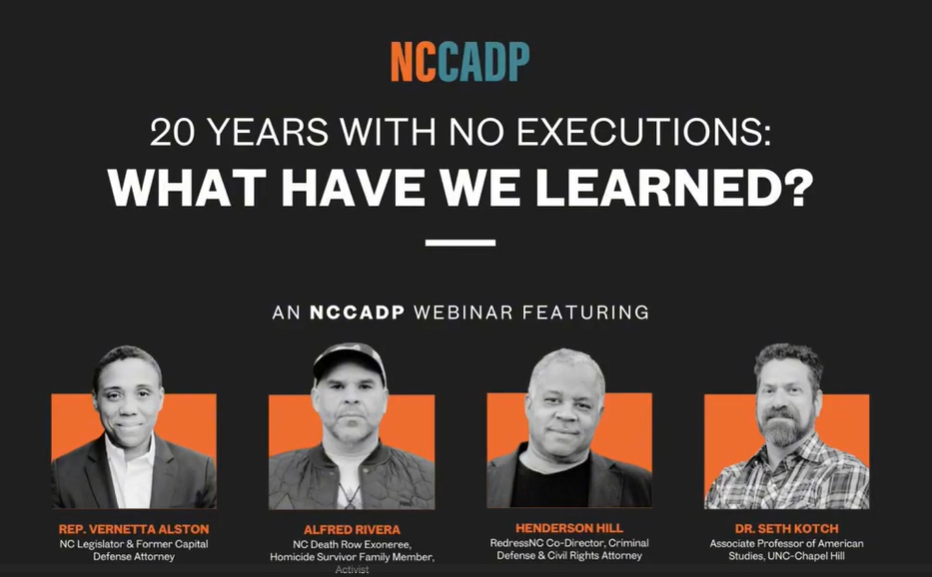
Webinar panelist Dr. Seth Kotch, associate professor of American Studies at UNC-Chapel Hill
and author of “Lethal State: A History of the Death Penalty in North Carolina,” explained why
the death penalty is historically racist: “The story of the death penalty is one of continuity, and
not change. … [It derives from an institution] designed to produce discriminatory outcomes.”
Kotch said 80% of people who were executed between 1600 and the Civil War were people of
color. Even after slavery ended, the drop in percentage was statistically insignificant, a mere two
percent. For comparison, North Carolina’s death row comprises 60% people of color, though the
state’s population is made up of roughly 40%.
Panelist Henderson Hill is a former criminal defense and civil rights attorney and current co-
director of RedressNC. Hill, who played a prominent role in passing the Racial Justice Act in
North Carolina in 2009, said research about the inherent racism of the death penalty was used to
pass the bill, which was repealed in 2013.
In his opening remarks, Hill commented, “When we talk about twenty-year anniversaries, the
instinct is to be celebratory. … It’s good that there’s been a cessation of executions, but it
doesn’t remove the trauma that many North Carolinians are walking around with every day of
their lives.” Hill himself represented clients on death row who were executed, so he is among
those who have been traumatized by the death penalty.
Panelist Alfred Rivera, a former death row resident who was wrongfully convicted in 1997 and
exonerated in 1999, echoed Hill: “I had to live through the fears that men were gonna be
executed. I would have to live through it, sleep through it, and wake up to it. … Today, the
trauma still exists.”
One of the men I befriended, George Wilkerson, wrote a book that touches on the traumatic
nature of the death penalty for those who are currently on death row, like himself. Despite the
fact that executions are halted, reminders of their sentences are everywhere: “red doors and jams,
sills and shelves, / red jumpsuits,” Wilkerson writes in his poem “Bone Orchard” in “Bone
Orchard: Reflections on Life under Sentence of Death.” The psychological torment is constantly
physically present, but some men, like George, forget they are there to die and may be reminded
at certain times more than others, like on the anniversary of their crime. (A few, like Terry
Robinson, maintain their innocence.)
But trauma alone isn’t enough to end the death penalty. Neither is racism, apparently. The reason
we still have the death penalty has to do with a few major myths: that it is a deterrent to crime,
that it increases public safety, and that the people on death row are monsters.
None of these is true. NCCADP executive director Noel Nickle pointed out during the webinar,
“States with the death penalty have higher homicide rates.”
Hill said because of politics, the death penalty “has little to do with achieving public safety.” I
asked about HB 307, also known as Iryna’s Law, which went into effect in December 2025.
Legislators who passed it said it would increase public safety.
“It’s an awful piece of legislation,” Hill said. It was passed so quickly “even the assembly
doesn’t know what’s in it.”
In my own research, I’ve learned that other things actually create public safety: anti-poverty
programs and legislation; restorative justice, which focuses on repairing relationships rather than
simply vengeance; substance use and abuse resources; mental health resources; and emotional
management and awareness education for all stages of development.
Even from a faith perspective, the death penalty makes no sense. Most religious traditions teach
forgiveness, mercy and compassion. Jesus, for instance, told followers to turn the other cheek
and to love their enemies. He befriended outcasts, and as Sister Helen Prejean reminds us in
“Dead Man Walking,” he himself received a death sentence.
What we’ve ultimately learned about the death penalty in the last 20 years is that we shouldn’t
have one. But culture is slow to change; hearts and minds must align in order to make progress.
In the meantime, my friends on death row and I will be waiting, hoping, praying, and trying to
help others see what we already know to be true.
Kat Bodrie is a poet, writer, editor, and publisher in Winston-Salem. She is the founder and
editor of bramble press and “bramble,” a free online poetry lit mag. She is also the director of
publications for the Execution Intervention Project and book editor for BleakHouse Publishing.
She is the author of “Toward a Unified Theory of Self” and “The Executioner’s Book of Prayer,”
and co-author of “Bone Orchard: Reflections on Life under Sentence of Death” (2nd edition),
and “Digging Deep: Writing for Self-Discovery, Healing & Transformation.” Learn more at